Definition of Artificial Intelligence
What is Artificial Intelligence?
Within the academic world, there is no broad consensus on a definition of the concept of artificial intelligence (Monett & Lewis, 2018 & Wang, 2019). The European work by Samoili and colleagues (2021) provides a comprehensive overview of definitions.
-
From a historical perspective, reference is often made to the work of pioneers such as Alan Turing (1912–1954) and John McCarthy (1927–2011). The term ‘artificial intelligence’ appears to have been used for the first time in the so-called 1955 Dartmouth Proposal. McCarthy (2007) offers the following definition of artificial intelligence:
It is the science and engineering of making intelligent machines, especially intelligent computer programmes. It is related to the similar task of using computers to understand human intelligence, but AI does not have to confine itself to methods that are biologically observable.
-
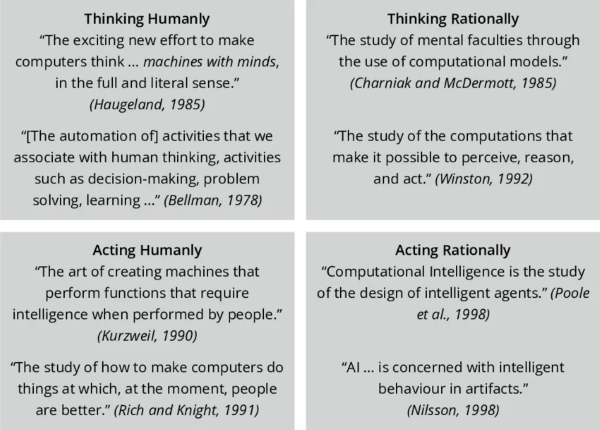
A commonly used academic definition is that of Russell & Norvig (2021), from a textbook used in many university courses on AI. This is not a single definition, but rather four different perspectives on the phenomenon of artificial intelligence, viewed from two dimensions: thinking versus acting and ‘human-like’ versus rational. In the third edition of the book (2010), there was a figure containing eight definitions illustrating these four perspectives:
-
From a more policy-oriented perspective, there is the – internationally widely accepted – definition provided by the OECD (Organisation for Economic Co-operation and Development), in the revised version of 2024. The original definition from 2019 was based on the conceptual framework set out by Russell & Norvig in their 2009 edition. It is important to note here that the definition refers to AI systems as a more tangible and action-oriented concept than AI, particularly within a policy context. The 2024 revision was deemed necessary to ensure the definition remained relevant and technically accurate in light of the rapid changes in available AI systems:
An AI system is a machine-based system that, for explicit or implicit objectives, infers, from the input it receives, how to generate outputs such as predictions, content, recommendations, or decisions that can influence physical or virtual environments. Different AI systems vary in their levels of autonomy and adaptiveness after deployment.
Topics typically encompassed by the term “AI” and in the definition of an AI system include categories of techniques such as machine learning and knowledge-based approaches, and application areas such as computer vision, natural language processing, speech recognition, intelligent decision support systems, intelligent robotic systems, as well as the novel application of these tools to various domains.
-
The OECD definition, in turn, forms the basis for the definition in the “EU Artificial Intelligence Act” (2024), a legal framework that is of great importance in Europe, particularly with regard to the use of AI within (higher) education:
‘AI system’ means a machine-based system that is designed to operate with varying levels of autonomy and that may exhibit adaptiveness after deployment, and that, for explicit or implicit objectives, infers, from the input it receives, how to generate outputs such as predictions, content, recommendations, or decisions that can influence physical or virtual environments.
Key aspects of these definitions
So what distinguishes an AI system from a non-AI system? It comes down to two characteristics that must be present simultaneously.
* Autonomy of the AI system
Once an AI system has been developed, it possesses a certain degree of autonomy, i.e. the system learns or acts without the need for human intervention. Human supervision may occur during any phase of an AI system’s lifecycle, but is not absolutely necessary.
* Adaptability
An AI system is a learning system: it adapts its output and any actions through interaction with new input or data. In doing so, it employs a form of so-called machine learning, whereby the system’s underlying data model is adjusted.