Definition of Generative Artificial Intelligence
What is generative artificial intelligence / GenAI?
Historically speaking, one could argue that research into artificial intelligence has been going on for about a century, without the technology having had a major impact on society. Every now and then, a news item would appear in the media about exceptional achievements by an intelligent computer, such as the IBM system Deep Blue which beat the reigning world champion Kasparov in chess matches in 1996–1997. But these were largely limited to exceptional achievements by supercomputers.
For many observers, 30 November 2022 marks the societal tipping point – that is, the moment when AI became a globally disruptive technology. This refers to the day of the public launch of ChatGPT by the company OpenAI. ChatGPT (Chat Generative Pre-training Transformer) is a generative AI system.
How is generative AI (GenAI) defined in the literature?
There is not yet a generally accepted definition in academic literature, as the concept of GenAI is relatively recent.
-
A frequently cited definition comes from the article ‘Generative AI’ by Feuerriegel et al. (2024):
The term generative AI refers to computational techniques that are capable of generating seemingly new, meaningful content such as text, images, or audio from training data.
-
Another frequently cited definition is that of Banh & Strobel (2023):
By utilising deep generative models, generative AI is capable of producing novel and realistic content across a broad spectrum (e.g., texts, images, or programming code) for various domains based on basic user prompts.
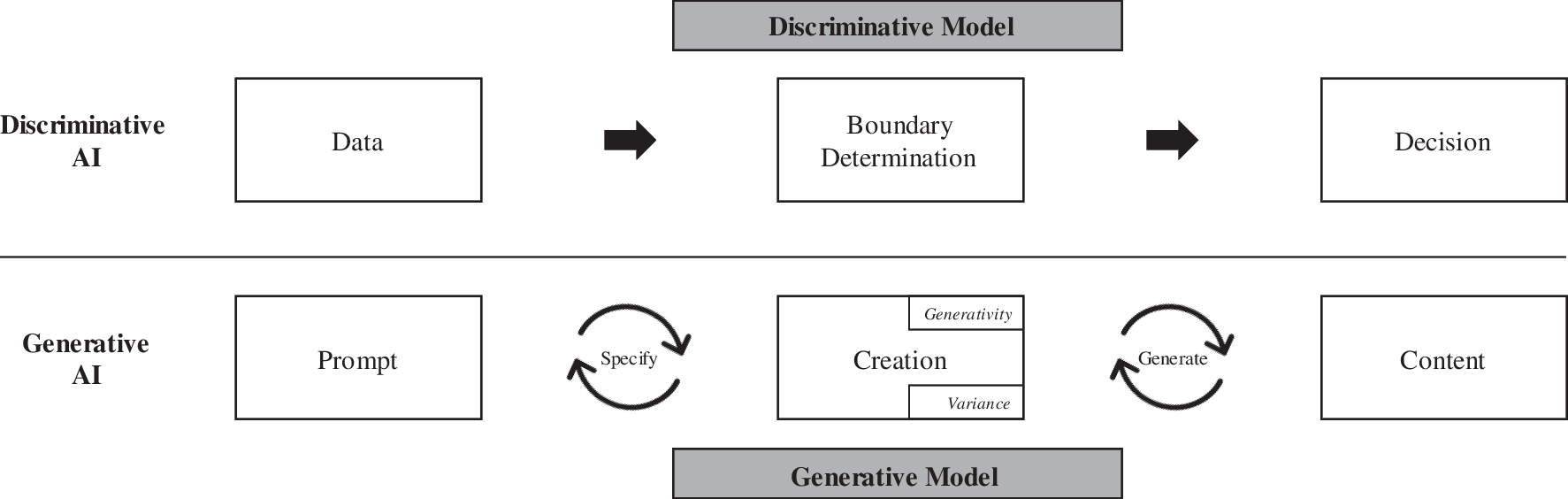
Both articles distinguish between generative and discriminative AI systems:
-
Discriminative AI uses large datasets to train the system to discriminate; for example, to learn to recognise certain animal species (cats) from a large number of photographs. Discriminative systems aim to make decisions that are as accurate as possible based on data. Through training, these decisions become increasingly correct and precise.
-
Generative AI uses large datasets to generate new data (content/output) based on probability, starting from a prompt or instruction created by a user. Generative systems aim to create content that is as plausible as possible based on data. Each prompt yields a different result:
For a single exact input prompt, a GAI application will generate varying outputs each time it is prompted, but the results remain valid and fulfil the prompt’s requirements. On the other hand, different input prompts can lead to the same outcome. Hence, formulating a meaningful prompt that leads to the desired outcome is a process of trial and error, for example, by rephrasing textual prompts using the same keywords. The field of prompt engineering involves systematically constructing prompts to improve the generated outputs. (Banh & Strobel, 2023, p.4).
-
In the UNESCO report “Guidance for generative AI in education and research”, Miao and Holmes (2023) provide the following definition (p. 8):
Generative AI (GenAI) is an artificial intelligence (AI) technology that automatically generates content in response to prompts written in natural-language conversational interfaces. Rather than simply curating existing webpages by drawing on existing content, GenAI actually produces new content. The content can take the form of any symbolic representation of human thought: texts written in natural language, images (including photographs, digital paintings and cartoons), videos, music and software code. GenAI is trained using data collected from webpages, social media conversations and other online media. It generates its content by statistically analysing the distributions of words, pixels or other elements in the data it has ingested, and by identifying and repeating common patterns (for example, which words typically follow which other words).
Whilst GenAI can produce new content, it cannot generate new ideas or solutions to real-world challenges, as it does not understand real-world objects or the social relationships that underpin language. Moreover, despite its fluent and impressive output, GenAI cannot be trusted to be accurate. Indeed, even the provider of ChatGPT acknowledges, ‘Whilst tools like ChatGPT can often generate answers that sound reasonable, they cannot be relied upon to be accurate.’ (OpenAI, 2023). More often than not, the errors will go unnoticed unless the user has a solid knowledge of the topic in question.
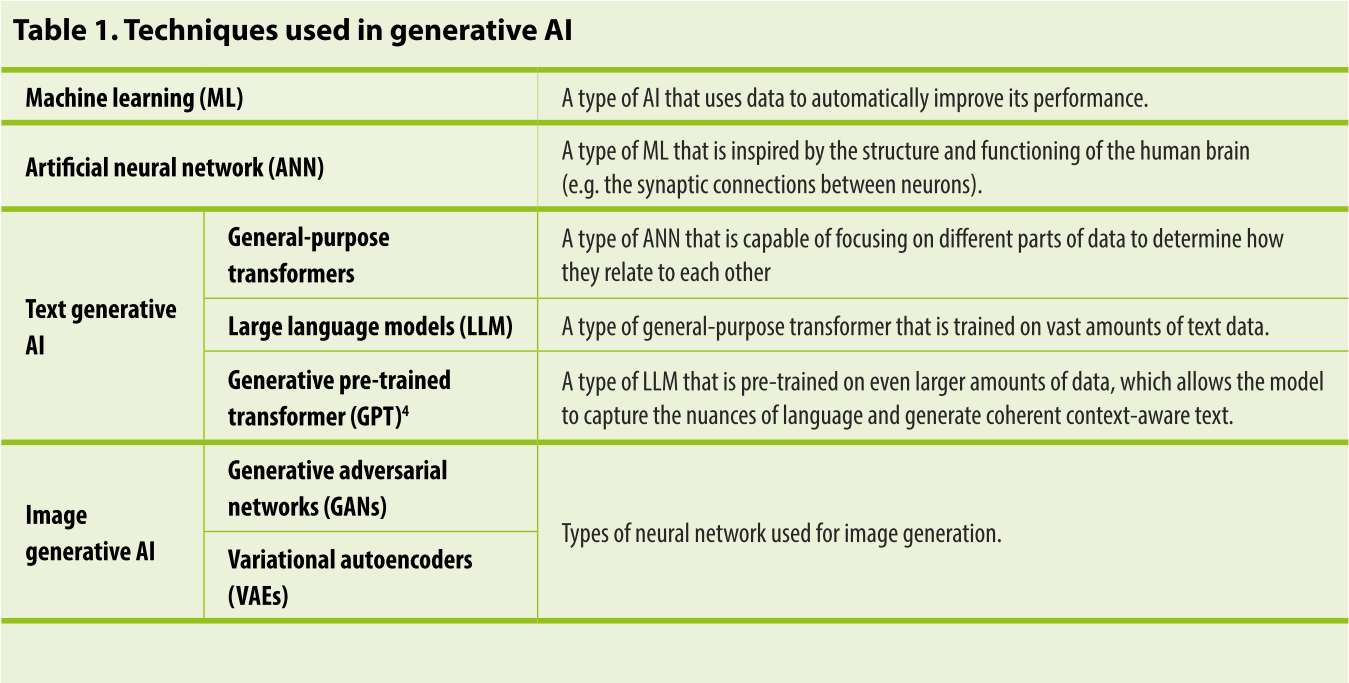
The definition by Miao & Holmes given above in the first part of the quotation was immediately followed by a warning regarding its use. Finally, the authors also provide a summary table bringing together the techniques in use at that time (p. 8):
Key aspects from these definitions
From the above definitions, we note the following key aspects:
- GenAI systems generate output based on large datasets (often large-language models), from which answers are predicted on the basis of statistical probability. Current GenAI systems do not, therefore, operate on the basis of reasoning, or on knowledge of the social, socio-cultural or human environment.
- GenAI systems produce new content for every question. Even with the same prompt, the answer to successive questions will differ.
- GenAI systems produce content that looks realistic, but not accurate content. GenAI output therefore has no truth value, only a probability based on the context provided in the prompt.