Scenario typologies
Combining both axes gives rise to four recognisable scenario typologies that describe possible relationships between professionals and AI. These typologies have been constructed inductively from the session data and are analytical in nature.
The typologies should not, however, be interpreted as fixed or empirically defined profiles of professionals, but rather as interpretative frameworks that help to make various possible positions within AI-integrated work processes visible and open to discussion. In practice, professionals may combine characteristics from multiple typologies or shift between positions depending on context, task, time pressure or organisational expectations.
However, given the project’s educational objective, they also take on a normative dimension: they help to define which professional position the curriculum aims to develop, and which positions the curriculum seeks to avoid.
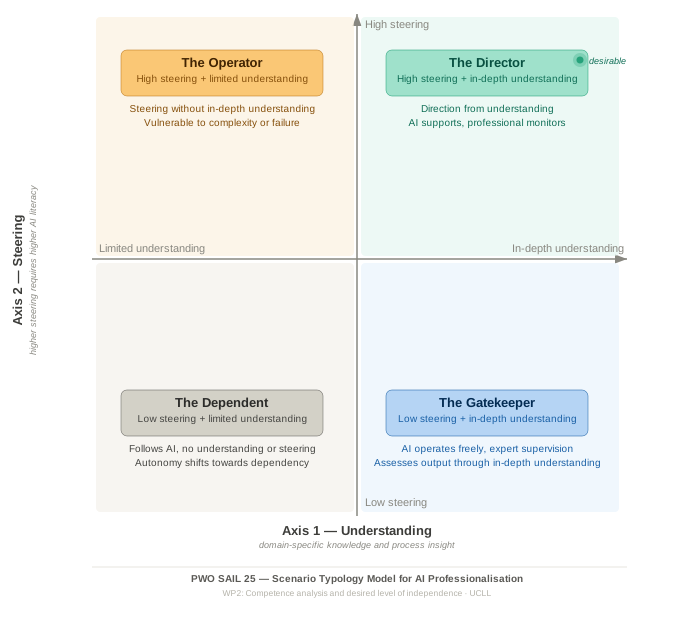
The four quadrants correspond exactly to the typologies described below. The green dot marks the desired end point: The Director. This is the scenario that both sessions set as the standard, but which is also the most demanding in terms of competences. The other typologies are not fixed end points, but describe directions in which curricula and professional practices may evolve when understanding, steering and critical professional practice come under pressure.
The decision to highlight the Director as the desired professional position is directly in line with the central objective of the PWO SAIL project: to support students in developing competences at a desired level of autonomy without becoming dependent on GenAI. Within this framework, the professional does not remain merely a user of AI output, but retains control over the content, critical judgement and responsibility for their professional practice. The Director thus represents not only an analytical scenario but also a pedagogical ambition: to support professionals in integrating AI in a conscious, critical and purposeful manner without relinquishing their professional judgement.
Furthermore, from the dispositional perspective adopted in this synthesis, the typologies describe not only differences in competencies, but also differences in the extent to which professionals actually apply their knowledge, critical judgement and responsibility within AI-integrated work processes. Consequently, professionals with comparable competences may, depending on their professional dispositions, fall into different typologies or shift between typologies depending on the context, time pressure or organisational expectations.