Definition of Explainable Artificial Intelligence
What is Artificial Intelligence?
Within the academic world, there is no broad consensus on a definition of the concept of artificial intelligence (Monett & Lewis, 2018 & Wang, 2019). The European work by Samoili and colleagues (2021) provides a comprehensive overview of definitions.
-
From a historical perspective, reference is often made to the work of pioneers such as Alan Turing (1912–1954) and John McCarthy (1927–2011). The term ‘artificial intelligence’ appears to have been used for the first time in the so-called 1955 Dartmouth Proposal. McCarthy (2007) offers the following definition of artificial intelligence:
It is the science and engineering of making intelligent machines, especially intelligent computer programmes. It is related to the similar task of using computers to understand human intelligence, but AI does not have to confine itself to methods that are biologically observable.
-
A widely used definition is that of Russell & Norvig (2021), from a textbook used in many university courses on AI. This is not a single definition, but four different perspectives on the phenomenon of artificial intelligence, viewed from two dimensions: thinking versus acting and ‘like humans’ versus rational. In the third edition of the book (2010), there was a figure containing eight definitions illustrating these four perspectives:
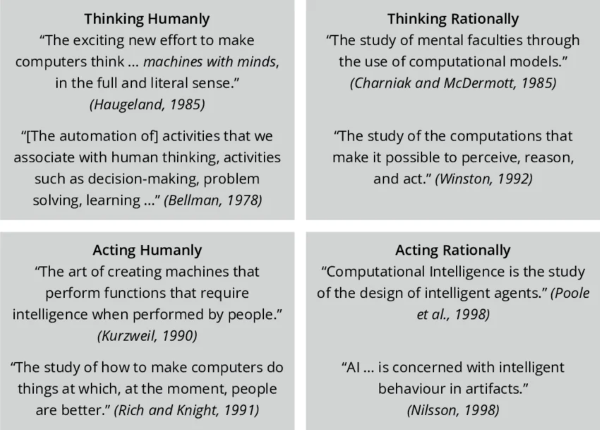
-
Finally, the “EU Artificial Intelligence Act” (2024) uses the following definition:
‘AI system’ means a machine-based system that is designed to operate with varying levels of autonomy and that may exhibit adaptiveness after deployment, and that, for explicit or implicit objectives, infers, from the input it receives, how to generate outputs such as predictions, content, recommendations, or decisions that can influence physical or virtual environments.
What is generative artificial intelligence?
Historically speaking, one could therefore argue that research into artificial intelligence has been ongoing for around a century, without the technology having had a major societal impact. Occasionally, a news item would appear in the media about exceptional achievements by an intelligent computer, such as the IBM system Deep Blue which won chess matches against the reigning world champion Kasparov in 1996–1997. However, initially these were limited to exceptional achievements by supercomputers, which were not considered to be far-reaching or disruptive.
Fundamental elements in the definitions
From the above definitions, we can identify the following fundamental aspects:
Artificial intelligence in an educational context
In educational literature, the term ‘artificial intelligence’ covers a broad spectrum of technologies. It is important to distinguish between different forms of AI that are relevant to education.
Generative AI
Generative AI refers to systems capable of producing new content — text, images, code — based on a prompt. The most prominent examples in an educational context are:
- Large language models (LLMs): ChatGPT (OpenAI), Claude (Anthropic), Gemini (Google)
- Image generators: DALL-E, Midjourney, Stable Diffusion
- Code assistants: GitHub Copilot, Cursor
Definition (Holmes et al., 2023)
“Generative AI refers to AI systems that can generate novel content — text, images, audio, video, or code — that did not exist in their training data, by learning patterns from large datasets.”
AI literacy
Cardona et al. (2023) identify four dimensions of AI literacy for education:
| Dimension | Description |
|---|---|
| Understanding | Knowing how AI works at a conceptual level |
| Using | Deploying AI tools effectively for learning tasks |
| Evaluating | Critically assessing AI output |
| Creating | Using AI for creative and complex tasks |
Distinction: automation vs. augmentation
An important conceptual distinction in the literature (Selwyn, 2022; Dillenbourg, 2023, Banihashem, et al., 2025) is that between:
- Automation: AI replaces human tasks (e.g. automatically marking multiple-choice questions) (Wiggins & McTighe, 2005)
- Augmentation: AI enhances human capabilities (e.g. AI as a sparring partner for writing)
The vast majority of the educational literature advocates an augmentation model in which the teacher and student remain central.
References
- Cardona, M. A., Rodríguez, R. J., & Ishmael, K. (2023). Artificial Intelligence and the Future of Teaching and Learning. U.S. Department of Education.
- Holmes, W., Porayska-Pomsta, K., Holstein, K., et al. (2023). Ethics of AI in Education. International Journal of Artificial Intelligence in Education, 32, 504–526.
- Selwyn, N. (2022). The Future of AI and Education. European Journal of Education, 57(4), 473–484.